
 |
 |
 |
 |
 |
 |
Anti-War Song: "PEACE"
words: Esther Talbot, April 4,1814
music: Roger Hall, September 24, 1981
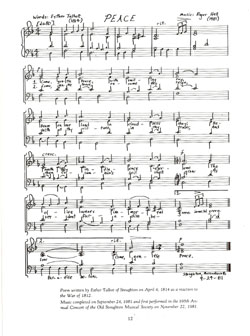
World Premiere Performance
November 22, 1981
in
"A Centennial Concert"
Celebrating the Dedication of Stoughton Town Hall in 1881
sung by soprano soloist, Karen Pritchard,
and chorus of the Old Stoughton Musical Society
accompanied by Kenneth Yates, organist
conducted by Roger Hall
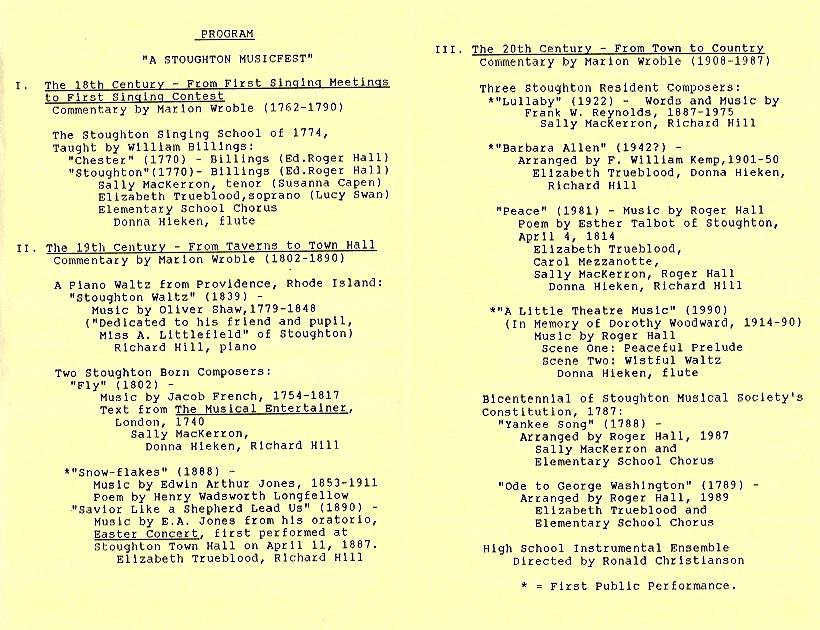
Revised version of "Peace"
for vocal quartet, flute, piano (see program above)
first performed in "A STOUGHTON MUSICFEST"
May 10, 1990
For Stoughton composer, 1814 peace poem still resonates
By Maria Cramer, The Boston Globe
Ten-year-old Esther Talbot took up her pen, dipped it in ink, and with near perfect penmanship
wrote the word "Peace" atop expensive paper.Most likely, this was how the girl from a prominent Stoughton family began her short poem in 1814,
almost two years after the start of the War of 1812 and just months before Francis Scott Key
penned "The Star Spangled Banner," according to Roger Hall. The local composer put her words to
music after finding the poem more than two decades ago while searching the archives of the
Stoughton Historical Society."She wasn't just talking about lilies in the field," Hall said.
She was writing an anti-war poem.
Come, gentle Peace, with smiling ray,
Beam on our land a cloudless day;
Beneath thy influence serene,
The olive wears immortal green.The two-stanza poem never mentions the war, but "its call for calm is telling," Hall said.
"She really was sort of summarizing what a lot of people felt at the time," he said. "People just
wanted the war to end."With the fighting in Iraq raising skepticism among many Americans, Hall,
who runs his music studio out of his home,
is calling all of his music contacts in search of a singer or choir to perform the
song, as well as another, "The Dark Night is Ending,"
written by poet John Greenleaf Whittier (1807- 1892).
"Peace" was first performed by a local choir in 1981
during the centennial celebration for the dedication of Stoughton Town Hall,
but Hall believes the time is right to release his song that may expresswhat many Americans are feeling.
"There are so few protest kinds of songs out there," Hall said.
"It seems unpatriotic to write something against war."
American history, however, is rich with poets who expressed anti-war sentiment.
Walt Whitman's experiences as an orderly in a military field hospital during the Civil War
transformed the tone of his poetry from ardent patriotism to vitriolic anger, said Mason Lowance,
professor of English and 19th-century American literatureat the University of Massachusetts at Amherst.
"The first stanza of 'Leaves of Grass' is very patriotic; the preface is extremely pro-American,"
he said. "Then the war comes seven or eight years later.He's up to his armpits, literally, in blood and gore, and he changes completely."
Anti-war poetry normally comes out of a specific event that touches the poet deeply, Lowance said.
Gail Mazur, a poet and author of "They Can't Take That Away From Me,"
a collection of poems, agreed.
The best antiwar poems tend to come from those who have experienced battle, she said.
The Vietnam War produced great poetry, including "Facing It," by veteran Yusef Komunyakaa,
about the Vietnam Veterans Memorial. But finding a successful contemporary poem calling for
peace or bemoaning the losses of war is difficult."I haven't seen it, partly because it's very hard to do it so well that you could see it published in
places," said Mazur, who teaches poetry at Emerson College. "I think the more authentic your own
experience, the more interesting it's going to be."When Talbot wrote her poem, the war was fought on American soil, making the events more real,
Hall said. "The war had been going on for a couple of years," he said."It was pretty bad there for a while. The British had sacked Washington, D.C., and there was
concern the country could have been lost completely."But for all the maturity she displayed in her poem, Talbot never rose to fame as a writer, Hall said.
According to an 1892 obituary Hall found, Talbot became a teacher, married, and had two children
before dying at age 89."She never failed to respond to an appeal for help from others in the time of sickness or
bereavement, and the hours she spent by the bedside of the sick and dying would aggregate many
days of her life," the obituary read.Reprinted courtesy of The Boston Globe, 2004
Esther Talbot Johnson Obituary
October 15, 1892
Was the daughter of Richard and Rebecca (Smith) Talbot,and was born in Stoughton, July 6th, 1803.
She possessed many of the strong and admirable traits of character which seem to have been common in New England., immediately succeeding the Revolutionary days and which almost every Stoughton family of that period furnished examples. She inherited an energy and courage which never deserted her, from the day when a Miss of only 14 years she was left motherless, with three sisters and a brother younger than herself, largely dependent on her for the attention and counsel a woman along can give, to this latter part of the century when she bravely and willingly went out to join the multitude of loved ones long before.
More than 70 years ago, at the age of 17, she began teaching school in Stoughton, a vocation which she pursued for several years in this and adjoining towns. The late Isaac Swan, who was so long and generally known in connection with the public schools, was one of her pupils, and often spoke with loving enthusiasm of her as his first teacher. After marriage her best efforts were directed towards the welfare of her family, but she never failed to respond to an appeal for help from others in the time of sickness or bereavement and the hours she spent by the bedside of the sick and dying would aggregate many days of her life.
She had an abiding faith in “Eternal Goodness” and the basis of her creed was contained in the legend which hung upon the wall of her room “Be not weary in well doing.”
She leaves a daughter, Mary R., a son Henri L., an aged sister, Rebecca Talbot,
and a brother, Newton Talbot.
This song is available with the sheet music by Roger Hall
plus picture of the original 1814 poem
and including an audio file (MP3) from the World Premiere Performance
in "A Centennial Concert" held in Stoughton, Massachusettson November 22, 1981
with the composer, Roger Hall, conducting
the soloist and Old Stoughton Musical Society Chorus
To order these items:
original Peace poem by Esther Talbot,
sheet music of the song,concert program from premiere of the song in 1981,
and audio from first performance (MP3)
the price is only $4.00
click the "Add to Cart" button below
to pay through Safe and Secure PayPal.
For any questions, send your email -- here
Read about the two versions of "Peace"
in Roger Hall's memoir book
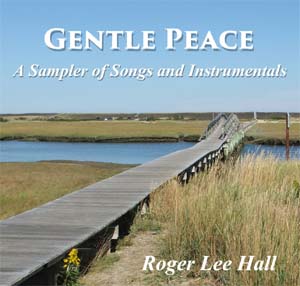
"Gentle Peace" - Songs For Survival
The two versions of "Peace" are on this CD --
the 1981 original for soprano soloist and chorus
and the 1990 revised version for solo vocal quartet, flute and piano:
To read about the "Gentle Peace" CD -- click here
See the "Peace" tune performed
in an arrangement by Steve Tapper for flute quartet
available on YouTube -- click here



Return to top of this page
© 2014/ Updated: 2026 PineTree Productions. All Rights Reserved for all original material on this website. Contact: pinetreepro@aol.com