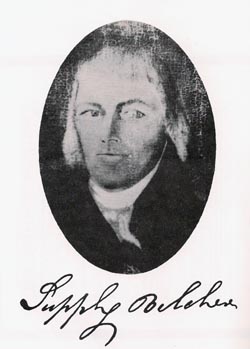
One of Belcher's strongest tunes is titled simply, "HEROISM"
His text was from the long ballad written
at the beginning of the American Revolution by Nathaniel Niles.
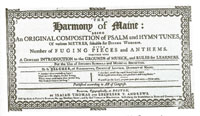
Only the first of fiteen verses was printed in Belcher's only tunebook,
THE HARMONY OF MAINE (published in Boston, 1794)
Here is that first verse:
Why should vain mortals tremble at the sight of
Death and destruction in the field of battle,
Where blood and carnage clothe the ground in crimson,
Souding with death groans.
This tune has been recorded by
The Oregon State University Choir on
a New World Records CD, 1976/1996 titled,
MAKE A JOYFUL NOISE - AMERICAN PSALMODY, 1770-1840
Another of his tunes was JUBILANT from his 1794 tunebook
which may have been written
to celebrate the
end of the American Revcolution.
This is the text:
Blow ye the trumpets blow, The gladly solemn sound,
Let all the nations know, To earth's remotest bound,
The year of Jubilee is come, Return ye ransom'd sinners home.
This tune was recorded by the Universiry of Maryland Chapel Choir
from the old LP album, "The American Harmony"
To listen to "Jubilant" by Supply Belcher -- click here
--Roger L. Hall, Musicologist
Director, Center for American Music Preservation
(CAMP)
See also: Singing Stoughton
.jpg)
Supply Belcher - Find A Grave
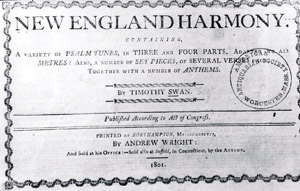
"Make A Joyful Noise" (Psalm 100) by Supply Belcher
from the 195th Annual Concert in 1981
sung by The Old Stoughton Musical Society Chorus
Roger Hall, conductor
on this audio album
"Make A Joyful Noise" -
The New England Harmony
(AMRC 0002)

Huntoon, Daniel T.V.
History of Canton, Norfolk County, Massachusetts, Cambridge, MA: John Wilson and Son, 1893.
Includes a chapter on music in Canton and Stoughton.
Huntoon lists Supply Belcher in the Fourth Company of minutemen
who were in the battles at Lexington and Concerd on April 19, 1775.
Jones, Mary (Swan) and Frank W. Reynolds
History of the Musical Society in Stoughton, no date.
Note: The sub-heading on the cover --"Formed in 1762"--
That date
is incorrect. This society was formed on January 1, 1802.
Standish, Lemeul, editor
The Old Stoughton Musical Society: An Historical and Informative Record of the Oldest Choral Society in America. Stoughton, Massachusetts, 1929.
Wikipedia entry - Supply Belcher
Music Collections
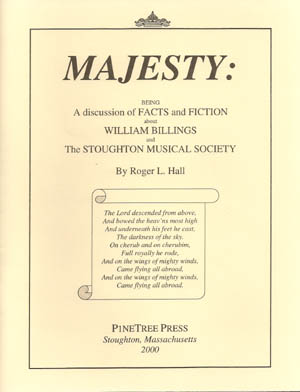
Contents:
PART ONE: William Billings - His Life and Music
1. Family Tree
2. Parents
3. Wife and Children
4. Occupations
5. Revolutionary Patriot
6. Singing Master and Composer
PART TWO: William Billings and Old Stoughton
7. The Singing School
8. The Stoughton Musical Society
9. First Tunebook
10. Second Tunebook
11. Chicago World's Exposition Concerts
12. Billings Tunes in Stoughton Concerts (1876-1986)
Notes
Bibliography
Discography
MUSIC SUPPLEMENT:
THE PLEASURES OF VARIETY (Text: William Billings/
Music: Roger Hall)
COME LET US SING (Text: William Billings/ Music: Roger Hall)
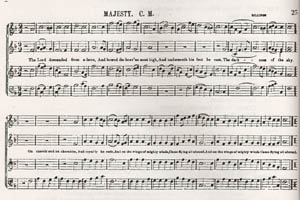
MAJESTY (music by William Billings, 1778)
STOUGHTON (music by William Billings, 1770, edited by Roger Hall)
Music Activities in Stoughton (1980-1999)
This monograph is in very limited supply and single copies may be ordered if still available by writing to:
MAJESTY
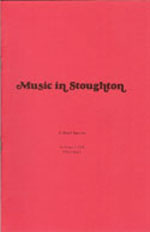
Music in Stoughton: A Brief Survey
This pamphlet, written by Roger L. Hall, covers the years from the first recorded singing meetings in 1762 to the Bicentennial of the Old Stoughton Musical Society's Constitution in 1987. It also includes other major music events such as: Oldest choral society in America organized (1786); Second musical society organized (1802); First oratorio by a local composer (1887); Only musical group representing early New England music at World's Columbian Exposition in Chicago (1893); George Washington Bicentennial Concert (1932), Old Stoughton Musical Society Bicentennial (1986).
At the back of the pamphlet are lists of Most Performed American Tunes (1879-1979) and Most Performed American Composers (1976-1986).
Also included is the song titled, "Peace," specially composed by Roger Hall in 1981 for the Centennial of Stoughton Town Hall. This song is based on an anti-war poem written by a Stoughton teenage girl in 1814 about the War of 1812.
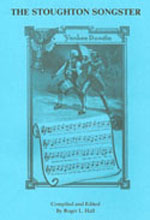
The Stoughton Songster
A collection compiled and edited by Roger L. Hall which includes the lyrics for 12 songs performed in Stoughton concerts between 1980 and 1990.
Included are songs by Stoughton composers:
Edwin A. Jones, Frank W. Reynolds, F.William Kempf, and Roger Hall.
Also there are original lyrics to "Yankee Doodle" and "Battle Hymn of the Republic."
All the songs are available on the accompanying CD, along with a radio special about the 200th anniversary of the Old Stoughton Musical Society in 1986.
The 12 song and hymn lyrics included in
The Stoughton Songster:
I. Pilgrim Poet:
1. "O Boston!" (poem: William Bradford/ tune: OLD HUNDRED) -- edited and arranged by Roger Hall for the 350th anniversary of the City of Boston in 1980.
II. George Washington's Time:
2. "Stoughton" (music by William Billings, 1770/ edited by Roger Hall) -- for the Bicentennial of the Old Stoughton Musical Society in 1986.
3. "Father and I Went Down to Camp" (tune: YANKEE DOODLE, ca. 1775)
4. "The 'Vention did in Boston meet" (tune: YANKEE DOODLE, 1788)
5. "Ode to George Washington" (text: Samuel Low/ tune: GOD SAVE THE KING, edited by Roger Hall,1982)
-- sung at the Inauguration of the First U.S. President in 1789.
III. Abraham Lincoln's Time:
6. "My Country 'Tis of Thee" (text: Samuel Francis Smith, 1831/ tune: GOD SAVE THE KING)
7. "John Brown's body lies a-mould'ring in the grave " (text printed by C.S. Hall, 1861/ tune: GLORY, HALLELUJAH,1861)
8. "Battle Hymn of the Republic" (text: Julia Ward Howe, 1862/ tune: GLORY, HALLELUJAH)
IV. Stoughton Songs:
9. "Old Stoughton" (music by Edwin Arthur Jones, 1886)
10. "Lullaby" (words and music by Frank W. Reynolds, 1922)
11. "Barbara Allen" (folk song arranged by F. William Kempf, 1942)
12. "Peace"(poem by Esther Talbot, 1814 / music by Roger Hall, 1981)

To read about Roger Hall's music preservation efforts, click on this link:
Saving Local Music
Mr. Hall is available to present his entertaining and educational lectures
for colleges, schools,
libraries, historical societies or other organizations.
See his sample music programs available at this link:
Lectures and Workshops
For any questions write to:
Supply Belcher - "The Handel of Maine"